
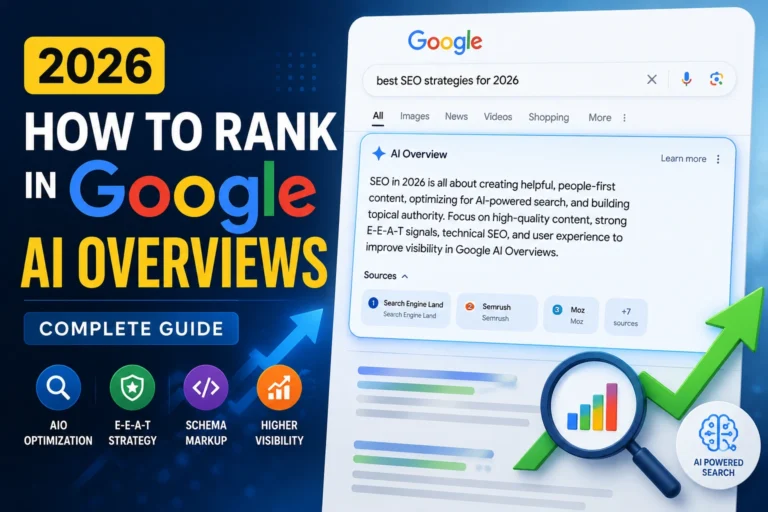
Search has fundamentally changed in 2026. If someone searches on Google today, the very first thing they see is not ten blue links, it is a fully synthesized AI-generated answer at the top of the page, citing multiple sources, and often answering the question before a single click happens.
This is Google AI Overviews (AIO) and it is now the most important visibility battleground in SEO.
According to research by BrightEdge, AI Overviews now appear in nearly 48% of all tracked search queries. For website owners and digital marketers, this is not a future trend. It is happening right now. The good news is that you can optimize your content to appear inside these AI-generated summaries and this guide explains exactly how to rank in Google AI Overviews in 2026, step by step.
What Are Google AI Overviews?
Google AI Overviews are AI-generated answer boxes that appear at the top of Google search results, powered by Google Gemini. Unlike featured snippets, which pull a single passage from one page, AI Overviews synthesize information from multiple sources and present a comprehensive answer directly on the SERP.
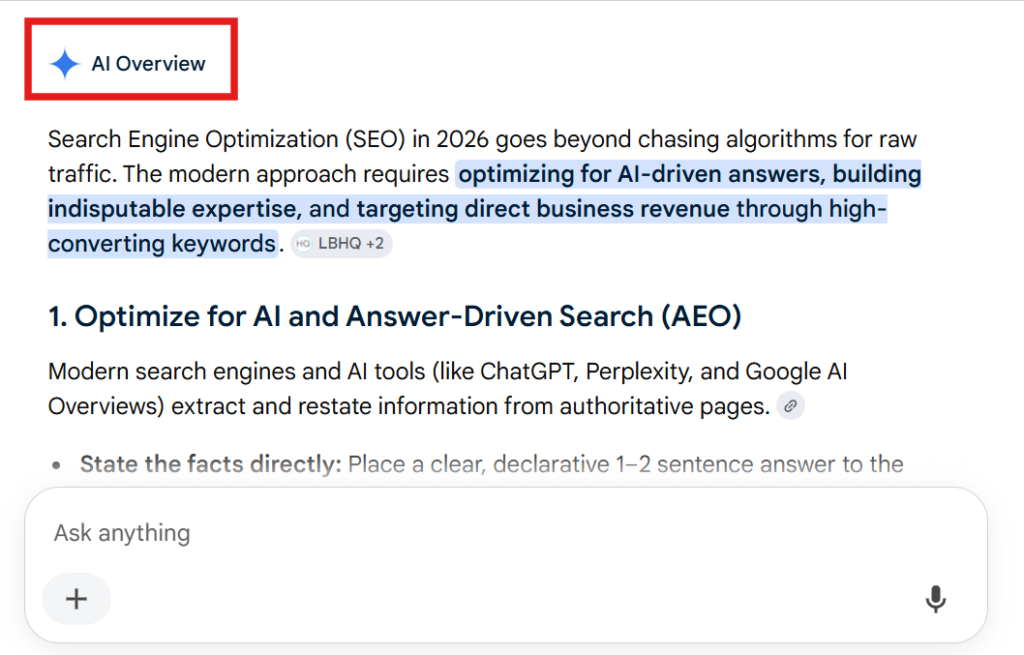
They are designed to answer complex, multi-part queries in one place. For users, this is convenient. For website owners, it is a double-edged sword.
Research by Ahrefs shows that the presence of an AI Overview correlates with a 58% lower average click-through rate for the top-ranking page. However, pages that are actually cited inside an AI Overview see a CTR lift of up to 35%. The goal, therefore, is not just to rank on page one but to become one of the cited sources inside the AIO box itself.
How Do Google AI Overviews Work?
Google AI Overviews do not simply reward the highest-ranking page. They work by identifying the most clearly structured, factually accurate, and contextually relevant content across multiple sources and synthesizing it into a single answer.
The system uses a technique called “query fan-out,” where a single user query is broken into multiple related sub-queries. Content that answers not just the primary question but also its related sub-questions has a significantly higher chance of being cited.
Key things Google evaluates include:
- Whether your content clearly answers the user’s query
- Whether your page demonstrates Experience, Expertise, Authoritativeness, and Trustworthiness (E-E-A-T)
- Whether your structured data helps Googlebot understand your content contextually
- Whether your site has established topical authority in its niche
- Whether your page loads quickly and is technically accessible
Understanding this is the foundation of Google AI Overviews optimization.
Why Google AI Overviews Matter for SEO in 2026
The numbers tell the story clearly.
By early 2026, Google AI Overviews appear in two-thirds of all search queries in the United States. Organic CTR for traditional blue links has fallen by approximately 34.5% on searches where an AI Overview appears. At the same time, pages cited inside AIO boxes are generating more qualified traffic than traditional position-one listings.
This means two things for your SEO strategy:
First, every day your content stays out of AI Overviews, your competitors are stealing your visibility and your potential customers. Second, traditional SEO metrics like keyword ranking alone no longer tell the full story of your search performance.
In 2026, AI Overview citation is not a bonus, it is the new number one ranking..
How to Rank in Google AI Overviews: 10 Proven Strategies
1. Build and Demonstrate E-E-A-T
E-E-A-T stands for Experience, Expertise, Authoritativeness, and Trustworthiness. Google has confirmed it is one of the most important signals for AI Overview citation selection.
Google’s AI crawlers actively look for content created by someone with genuine expertise and first-hand experience in the subject. If your content simply repeats what everyone else has written, Google will skip it and cite someone else instead.
Here is what E-E-A-T implementation looks like in practice:
Experience: Publish content written by practitioners with real, hands-on experience. Include first-person insights, original observations, and practical examples that only someone with direct experience could provide.
Expertise: Align your content tightly with your core service area. Remove or consolidate off-topic content that dilutes your topical focus. Use “semantic triple” sentence structures, which are direct, standalone statements that clearly communicate a fact, making it easy for AI models to extract and cite.
Authoritativeness: Add author bios with credentials, link to your LinkedIn profile, and use Organization and Person schema to identify the people behind your content. Seek mentions and coverage from reputable third-party sites in your niche.
Trustworthiness: Regularly refresh older content with updated statistics and insights. Maintain consistent canonical URLs. Back every claim with credible data sources.
A practical example of E-E-A-T working at scale: After the March 2024 Google Core Update, several major content sites experienced significant organic traffic declines when their content drifted away from core expertise and E-E-A-T signals. Sites that refocused on topical authority, tightened content coverage, and implemented author schema consistently reported measurable improvements in AI Overview citation rates reinforcing that E-E-A-T is not optional for AIO visibility.
2. Write Clear, Extractable Answers
The single most important content change you can make for AI Overviews optimization is to make your answers easy to extract.
AI models do not read your entire article the way a human does. They scan for standalone, clearly written passages that directly answer a specific question. If your content buries the answer inside a long introduction or uses vague, non-committal language, it will be skipped.
Follow the “answer first” approach for every major section of your content:
- Place a direct 40 to 60 word answer immediately under each H2 heading. This is called an answer capsule, and it is the format AI Overview systems are most likely to cite.
- Write in plain, conversational language that mirrors how users naturally ask questions.
- Use active voice and avoid pronouns like “it” or “they” that require context to understand.
- Keep sentences short and factual. Each sentence should be able to stand alone.
Research confirms that 44.2% of all AI citations come from the first 30% of a page’s content. Get your most important points near the top.
3. Target Question-Based and Long-Tail Keywords
Choose the wrong keyword, and Google will never trigger an AI Overview no matter how good your content is.
According to Ahrefs data, 99.2% of keywords that trigger AI Overviews have informational intent. These are keywords that begin with how, what, why, does, is, and similar question-based prompts. Long-tail question queries of eight or more words show the highest AIO trigger rates.
For AI Overviews SEO, your keyword strategy should include:
- Primary informational keywords such as “how to rank in Google AI Overviews” and “how to optimize content for AI Overviews”
- Question-based subheadings that directly mirror People Also Ask queries for your topic
- Conversational long-tail variations such as “how do I get my website to appear in Google AI Overviews” and “what content does Google AI Overviews cite”
- Related semantic keywords like GEO (Generative Engine Optimization), AEO (Answer Engine Optimization), AI search optimization, and topical authority
Use Google Autocomplete, the People Also Ask section, and Related Searches to build your list. These are free tools that directly show you what AI systems are being asked about your topic.
4. Implement Structured Data and Schema Markup
Structured data is one of the highest-impact, lowest-effort optimizations you can make for AI Overviews visibility. Schema markup feeds Google’s Knowledge Graph, helping AI crawlers understand not just what your content says but what it means contextually.
The schema types most relevant for AI Overview optimization in 2026 are:
- FAQPage schema for question-and-answer sections
- HowTo schema for step-by-step instructional content
- Article or BlogPosting schema for standard blog content
- Organization and Person schema for E-E-A-T signals
- BreadcrumbList schema for site structure clarity
A few important notes on implementation: Use nested schema structures that create entity relationships between your content elements, since AI models detect these relationships when assessing authority. Always label the author, publishing date, and topic category clearly within your schema. After implementing or updating schema, use Google Search Console’s Structured Data Report to verify correct implementation and request reindexing.
5. Build Topical Authority Through Content Clusters
Google AI Overviews do not evaluate individual pages in isolation. They assess the depth of your site’s knowledge across an entire subject area. A single well-written blog post is not enough. You need a content cluster.
A content cluster consists of one comprehensive pillar page covering a broad topic supported by multiple detailed supporting articles on specific subtopics, all internally linked together.
For example, if your pillar page targets “SEO for small businesses,” your supporting content should cover keyword research, on-page SEO, technical SEO, backlink building, local SEO, and content marketing as separate, interlinked posts. This signals to Google that your site is a genuine authority on the subject, not just a page that mentions the keyword.
Internal linking is critical here. Every supporting page should link back to the pillar page, and the pillar page should link out to each supporting article. Use descriptive anchor text that includes relevant keywords, not generic phrases like “click here.”
6. Optimize Your Content Structure
How your content is organized matters as much as what it says for AI Overviews ranking.
AI systems parse your page the way a highly efficient reader would, scanning headings first to understand structure, then diving into specific sections for answers. If your structure is unclear or inconsistent, AI will skip your page in favor of one that is easier to extract from.
Follow these structural best practices:
- Use a logical H1, H2, H3 hierarchy throughout your content
- Write question-based H2 and H3 subheadings that reflect actual search queries
- Include a table of contents for longer posts to signal organized structure
- Use bullet points and numbered lists to make information scannable
- Add a dedicated FAQ section at the end of every post targeting People Also Ask queries
- Keep paragraphs to a maximum of 3 to 4 lines
The inverted pyramid structure works best for AI-optimized content. State the conclusion or direct answer at the beginning of each section, then provide supporting context and detail afterward.
7. Strengthen Your Brand Entity Signals
AI Overviews do not just evaluate individual pages. They evaluate brands and entities.
Google’s Knowledge Graph stores information about real-world entities, including businesses, people, and organizations. The stronger your brand’s entity signals, the more likely Google is to trust and cite your content in AI-generated answers.
To strengthen your brand entity:
- Ensure your business name, address, phone number, and website are consistent across all directories, review platforms, and social profiles
- Create or update your Google Business Profile with complete, accurate information
- Seek brand mentions from reputable industry publications, forums, and relevant websites
- Maintain an active presence on LinkedIn, and link your website to your LinkedIn company page
- Submit accurate information to data aggregators and business directories
Brand search volume also correlates with AI visibility. The more people search for your brand by name, the stronger your entity signals become.
8. Ensure Technical SEO and Crawlability
No amount of content optimization will help if Google cannot efficiently crawl and index your pages. Technical SEO remains the foundation of AI Overview visibility.
Key technical requirements for 2026 AIO optimization:
- Page speed: Slow-loading pages are less likely to be trusted by AI crawlers. Aim for an Interaction to Next Paint (INP) score under 100ms.
- Mobile optimization: AI search heavily favors mobile-optimized pages. Ensure your site renders correctly across all screen sizes.
- Robots.txt: Confirm that Googlebot is not accidentally blocked from crawling your important pages.
- XML sitemap: Keep your sitemap updated and submitted through Google Search Console.
- Core Web Vitals: Regularly audit your Core Web Vitals scores and address any failing pages.
- Canonical tags: Use canonical URLs consistently to prevent duplicate content issues.
After every significant content update, request reindexing through Google Search Console. This speeds up the process of Google recognizing your optimizations, with updates often reflecting within 5 to 12 hours.
9. Add Multimedia and Multimodal Content
AI Overviews are not text-only. Google’s AI models are multimodal, meaning they can process and reference text, images, and video content. Mix your content formats text, images, structured data — or watch competitors get cited instead of you.
Practical steps to make your content multimodal:
- Add descriptive, keyword-rich alt text to every image
- Use clear, descriptive filenames for images rather than generic names like IMG_001.jpg
- Include relevant infographics, comparison tables, and data visualizations
- Embed short-form videos (60 to 90 seconds) that summarize key points from your post
- Add video sitemaps to help Google index your video content separately
Research shows that pages combining text, images, and structured data earn significantly higher AI Overview citation rates than text-only pages.
10. Track and Monitor Your AI Overview Performance
Stop relying on rank checkers they cannot see AI Overview citations, and you are flying blind if you do. It requires a different monitoring approach.
Google Search Console remains the starting point. Check your Impressions and CTR data for informational queries, and look for traffic patterns that suggest AI Overview citations. Note that Google Search Console currently mixes AI Overview data with traditional organic data, so manual tracking is also necessary.
Manual tracking: Run your 10 to 20 most important target keywords in Google each week and note whether an AI Overview appears and whether your site is cited. Track this consistently over time to identify trends.
Third-party tools: Platforms like SE Ranking’s AI Overview Tracker, Semrush’s AI Overview Reports, and Ahrefs AI Overview Analysis provide more granular visibility data.
Initial results from AIO optimization typically appear within 30 to 60 days for well-optimized sites with existing SEO foundations. Significant improvement generally requires 3 to 6 months of consistent effort.
Traditional SEO vs. AI-Native SEO: What Has Changed
| Factor | Traditional SEO | AI-Native SEO (2026) |
| Primary goal | Rank on page one | Get cited in AI Overview |
| Content format | Keyword-optimized articles | Answer-capsule structured content |
| Authority signals | Backlinks | E-E-A-T + brand entity signals |
| Keyword strategy | High-volume exact match | Question-based long-tail queries |
| Schema markup | Optional | Essential |
| Success metric | Keyword ranking position | AI citation frequency + CTR |
| Content depth | Individual pages | Topic clusters |
Common Mistakes That Prevent AI Overview Citations
Writing long introductions without a direct answer. AI crawlers skip pages that bury the answer. State your key point within the first 50 to 60 words of each section.
Publishing unverified claims without data. AI systems prioritize factually accurate, source-backed content. Every significant claim should reference a credible study, report, or data point.
Ignoring schema markup. Unstructured content is significantly harder for AI to parse and cite. Schema markup is not optional in 2026.
Producing thin content on multiple similar topics. Scattered, shallow coverage signals low topical authority. Consolidate thin posts and build comprehensive cluster content instead.
Blocking AI crawlers in robots.txt. Content that cannot be crawled cannot be cited. Verify your robots.txt allows Googlebot and relevant AI crawlers full access.
Never updating old content. AI systems favor freshness. Regularly revisit older posts with new data, updated statistics, and refreshed examples.
How Long Does It Take to Rank in Google AI Overviews?
Appearing in AI Overviews typically takes 2 to 6 months after publishing optimized content, depending on your site’s existing domain authority and the competitiveness of your target keywords. Sites with established topical expertise in their niche often see faster results.
Technical fixes, such as correcting robots.txt errors or fixing schema issues, can produce visible improvements within days. Content optimization for AI extractability typically shows measurable citation improvements within 4 to 8 weeks. Authority-building signals like brand mentions and backlinks take 3 to 6 months to compound.
The important thing is to start now. Citation patterns are forming in 2026, and the brands establishing AI Overview visibility today will have a compounding advantage that becomes increasingly difficult to displace.
Frequently Asked Questions
What are Google AI Overviews?
Google AI Overviews are AI-generated answer summaries powered by Google Gemini that appear at the top of search results. They synthesize information from multiple web sources to directly answer a user’s query without requiring a click.
How do I get my website to appear in Google AI Overviews?
To appear in Google AI Overviews, your content must be clearly structured with direct answer capsules under each heading, backed by strong E-E-A-T signals, supported by schema markup, and published on a site with established topical authority in its subject area.
Does ranking on page one guarantee inclusion in AI Overviews?
No. Research shows that 80% of URLs cited in AI Overviews do not rank in Google’s traditional top 10 results. AI Overviews prioritize content clarity, credibility, and extractability over ranking position alone.
Can small businesses rank in Google AI Overviews?
Yes. AI Overviews often favor content that demonstrates specific, hands-on experience over generic corporate content. A specialized small business or agency with deep expertise in a niche can outperform larger competitors if their content is well-structured and authoritative.
How do I track if my site appears in Google AI Overviews?
Start by manually searching your target keywords in Google weekly and noting AIO appearances. Use Google Search Console to track impression and CTR trends. Third-party tools like SE Ranking’s AI Overview Tracker and Semrush’s AI Overview Reports offer more detailed monitoring.
What is the difference between GEO and AEO?
GEO (Generative Engine Optimization) refers to optimizing content to be cited in AI-generated answers across platforms like Google AI Overviews, ChatGPT, and Perplexity. AEO (Answer Engine Optimization) specifically focuses on optimizing for direct-answer features like featured snippets and AI Overviews. Both are essential components of a modern SEO strategy in 2026.
Final Thoughts
Google AI Overviews are not a temporary feature. They are the new front page of Google, and in 2026 they will appear in nearly half of all search queries. If your website is not optimized to appear inside these AI-generated summaries, you are ceding visibility to competitors who have adapted.
The strategies in this guide are not theoretical. They are grounded in real data, real case studies, and the actual ranking factors Google’s AI systems use to select citations. Start with E-E-A-T, structure your content for extractability, implement schema markup, build topical authority through content clusters, and monitor your performance consistently.
Implementing all of these strategies consistently from schema markup to content clusters to E-E-A-T signals takes time, expertise, and ongoing effort. For many businesses, the fastest path to AI Overview visibility is working with a team that already understands the landscape.
If you want expert help optimizing your website for Google AI Overviews and the evolving AI search landscape, Easy Client Hub’s SEO services are built specifically for this. Our team works with businesses of all sizes to improve search visibility, AI citation rates, and organic performance in 2026 and beyond. Contact us today to get started.