Ask ten marketers this question and you will get ten different answers. Some say Google is already dying. Others say nothing has changed at all. The truth sits in the middle, and the actual 2026 numbers tell a much clearer story than the panic headlines do.
If you run a small business or manage a website, this is not just a theoretical debate. It changes how you should be writing content, structuring pages, and thinking about traffic in general.
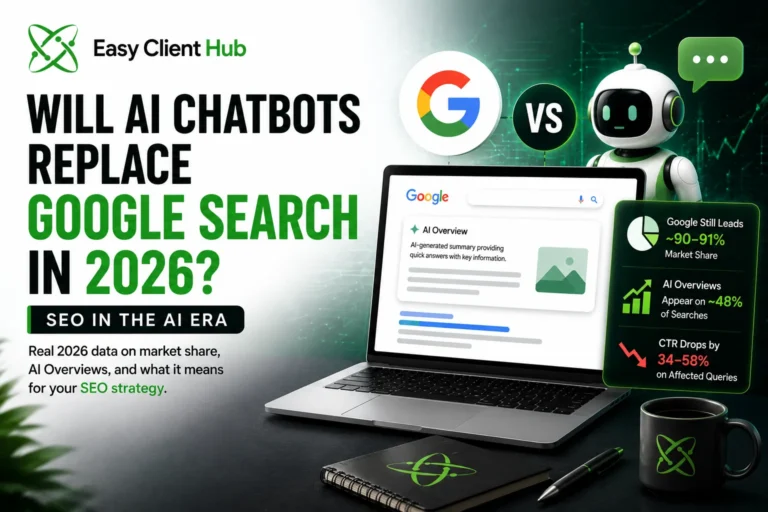
Quick Answer: No, AI chatbots have not replaced Google Search. Google still holds roughly 90 to 91 percent of the global search market as of 2026, according to StatCounter, even as ChatGPT crosses 1 billion monthly users. What has actually changed is Google’s own AI Overviews, which Ahrefs and Pew Research both found cut organic click-through rates by roughly 34 to 58 percent on affected queries.
Is Google Losing Market Share to AI Chatbots?
Not really, at least not in the way most people assume. Google still controls roughly 90 to 91 percent of the global search market as of mid-2026, according to StatCounter, the industry-standard tracker of search engine usage. That number has barely moved despite two years of AI hype (StatCounter Global Stats).
ChatGPT crossed 1 billion monthly active users in May 2026, according to Sensor Tower data reported by CNBC, making it the fastest app in history to hit that milestone (CNBC). That sounds massive, and it is. But raw usage and search referral traffic are two very different things, and Google still dominates the second one by a wide margin.
People are using AI chatbots constantly. They are just not using them to browse the open web the way Google users do.
Google vs. AI Chatbots: 2026 Snapshot
| Metric | Google Search | AI Chatbots (Combined) |
|---|---|---|
| Global search market share | ~90–91% | ~2–3% of search-like queries |
| Monthly active users | 5+ billion | ChatGPT: 1 billion+ |
| Strongest use case | Local, transactional, product searches | Research, ideation, conversational Q&A |
| AI Overview presence on Google | ~48% of queries | N/A |
Sources: StatCounter Global Stats, CNBC / Sensor Tower, Ahrefs
How Much Traffic Are AI Overviews Actually Taking?
This is where the real disruption is happening, not from chatbots, but from Google’s own AI Overviews. Third-party tracking tools like Ahrefs, which monitor AI Overview presence across hundreds of thousands of keywords, show the feature now appearing on a large and growing share of Google searches, especially informational queries (Ahrefs).
Ahrefs ran the most cited independent study on this. Analyzing 300,000 keywords, its research team first found that AI Overviews correlated with a 34.5 percent lower click-through rate for the top-ranking page compared to similar keywords without an AI Overview (Ahrefs). A follow-up analysis using December 2025 data found the drop had nearly doubled to 58 percent for position 1 results, with position 2 losing about half its clicks and position 10 still down nearly 20 percent (Ahrefs research via Business Wire).
Pew Research Center ran a separate, independently designed study tracking the real browsing behavior of 900 U.S. adults across nearly 69,000 Google searches. It found that when an AI Overview appeared, only 8 percent of visits resulted in a click on a standard search result, compared to 15 percent when no AI Overview was present, almost double (Pew Research findings via Search Engine Land).
There is a small silver lining here. Data from Seer Interactive shows CTR on AI Overview pages recovering slightly in early 2026, climbing from a low of 1.3 percent in December 2025 to 2.4 percent by February 2026 (Search Engine Land). It is not a full recovery, but it shows the drop is not permanent or one-directional.
Will AI Chatbots Ever Fully Replace Google?
Probably not anytime soon, and here is why. Google still dominates anything involving local intent, product comparison, or real-time information, things like “plumber near me” or “best laptop under 800 dollars.” AI chatbots are not built to pull live map data, verified reviews, or inventory in the same way.
E-commerce searches are a good example of this gap. Ahrefs’ research found that AI Overviews appear on 99.9 percent of informational keywords, but on less than 5 percent of transactional and shopping queries (Ahrefs data cited by Analyze.ai). People still want to compare real options before spending money, not just take one AI-generated answer as final.
What is actually happening is a blend, not a replacement. Google is absorbing AI into its own results instead of losing the war to outside chatbots entirely.
What Does This Mean for SEO in 2026?
SEO is not dying, but it is expanding into something bigger, often called Generative Engine Optimization, or GEO. This means writing content that both Google’s crawlers and AI models can understand, trust, and cite as a source.
If you want your website to actually show up inside AI Overviews instead of losing clicks to them, structure matters more than ever. Our guide on how to rank in Google AI Overviews breaks down the exact formatting and content patterns that tend to get cited.
Understanding the difference between old-school keyword stuffing and how AI models actually read content also matters here. We cover this in detail in our guide to AI SEO and LLMO, which explains how large language models decide what content is worth quoting.
How Can Small Businesses Prepare for AI Search?
Start with your content structure. Answer the actual question in the first two sentences of any section instead of burying it under three paragraphs of introduction. AI models and Google both reward direct, scannable answers.
Next, focus on real E-E-A-T signals, meaning genuine experience, expertise, authority, and trust. Generic filler content written just to hit a word count is exactly what gets ignored by both AI Overviews and normal search rankings.
Technical basics still matter too. Broken schema markup, slow load times, and messy site structure hurt you in AI search just as much as they hurt you in traditional Google rankings, sometimes worse since AI tools are pickier about crawlable, well-structured pages.
If you are not sure where your website currently stands on any of this, our SEO services team can run a full audit and show you exactly what needs fixing before your competitors get there first.
Should You Still Invest in Traditional SEO?
Yes, and the data backs this up clearly. Since traditional SEO and AI SEO now overlap more than they compete, businesses that ignore either one are leaving visibility on the table.
Google is still sending the overwhelming majority of search traffic on the internet. Betting your entire strategy on AI chatbot traffic right now would mean chasing a small, emerging channel while ignoring the roughly 90 percent of search volume that still runs through Google.
Final Thoughts
AI chatbots are changing how people research and ask questions, but they have not replaced Google, and the 2026 numbers make that pretty clear. What has changed is how search results look and how content needs to be built to survive inside them.
Businesses that adapt early, by optimizing for both classic SEO and this new AI layer, will keep pulling traffic while others lose it to zero-click searches. If you want a strategy built around where search is actually headed instead of where the headlines say it is, reach out and we will map it out together.
Sources
- StatCounter Global Stats – Search Engine Market Share Worldwide
- CNBC – ChatGPT Hits a Billion Monthly App Users (Sensor Tower data)
- Ahrefs – Google AI Overviews: All You Need to Know
- Ahrefs – AI Overviews Reduce Clicks by 34.5%
- Ahrefs Research via Business Wire – AI Overviews Now Cost Websites 58% of Their Clicks
- Pew Research Center findings via Search Engine Land
- Search Engine Land – AI Overviews CTR Recovery Study (Seer Interactive data)
- Ahrefs data cited by Analyze.ai – AI Overviews by Query Type
FAQs
Will AI chatbots completely replace Google Search?
No. Google still holds around 90 to 91 percent of global search market share as of 2026, according to StatCounter, even with ChatGPT surpassing 1 billion monthly active users.
How many Google searches now show an AI Overview?
AI Overviews appear on roughly 48 percent of all Google searches in 2026, and that share continues to grow across most industries.
Does an AI Overview hurt my website’s click-through rate?
Yes, in most cases. Ahrefs measured a CTR drop of 34.5 percent in early studies, rising to 58 percent for position 1 results by December 2025, though early 2026 data shows some recovery.
What is GEO in SEO?
GEO stands for Generative Engine Optimization. It means structuring and writing content so AI models like ChatGPT and Google’s AI Overviews can understand it and cite it as a trusted source.
Should small businesses still invest in SEO in 2026?
Yes. Traditional search still sends the vast majority of online traffic, and strong SEO fundamentals also improve your chances of being cited inside AI-generated answers.