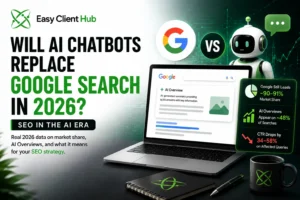

Most people who search Google in 2026 never click a single link.
AI tools like ChatGPT, Google Gemini, and Perplexity read hundreds of websites and generate a direct answer in seconds. Your website either appears in that answer or it does not exist for that user.
This shift has created an entirely new discipline in digital marketing called AI SEO and LLMO. In this guide, we break down exactly what these terms mean, why they matter for your business, and the five steps you can start today to get your content cited by AI search tools.
What Is AI SEO?
AI SEO is the practice of optimizing your website so that AI-powered search platforms can discover, understand, and recommend your content in their generated answers.
Traditional SEO gets your page onto Google’s first page. AI SEO gets your content into the actual answer that ChatGPT, Gemini, or Perplexity delivers to the user often before they ever visit a website.
At Easy Client Hub, we have seen this shift firsthand while working on SEO campaigns for clients across multiple industries. Websites that structure their content clearly and build genuine authority are getting cited by AI tools regularly while websites relying on old keyword-stuffing tactics are losing visibility fast.
The core idea is simple. AI tools behave like a very smart research assistant. They scan the web, pick the most trustworthy and clearly written sources, and summarize them into an answer. Your job is to be one of those trusted sources.
What Is LLMO?
LLMO stands for Large Language Model Optimization. It is the specific practice of writing and structuring content so that the AI models powering tools like ChatGPT, Google Gemini, Claude, and Perplexity can understand it clearly, trust it fully, and cite it confidently.
Think of it this way. Google’s traditional algorithm looks at keywords, backlinks, and page speed. An AI language model reads your content the way a human reader would checking whether the writing is clear, whether the information is accurate, and whether the source is trustworthy.
LLMO is about making your content pass that test.
You will also hear related terms like GEO (Generative Engine Optimization) and AEO (Answer Engine Optimization). Here is how they connect:
- AI SEO — the complete strategy for being visible in AI-powered search
- LLMO — optimizing content specifically for how language models process it
- GEO — getting cited in AI-generated summaries and answers
- AEO — appearing in featured snippets and voice search results
All four overlap. For most small businesses and digital agencies, AI SEO and LLMO cover everything you need to get started.
How Do AI Tools Like ChatGPT Find Your Content?
Understanding this is the key to everything. AI tools discover your content through two distinct pathways.
Pathway 1 — Training data
Every major language model is trained on billions of web pages scraped from the internet. If your website has been published, indexed, and mentioned across multiple sources, the AI model may already know about your brand before a user ever asks a question.
This is why building consistent brand mentions through backlinks, guest posts, social profiles, and directory listings is not just an SEO tactic anymore. It is how you train AI tools to recognize your business as a legitimate authority.
Pathway 2 — Live web search (RAG)
When a user asks ChatGPT or Perplexity a question today, the AI does not rely only on its training data. It performs a live web search in the background, reads the top-ranking pages it finds, and builds its answer from that fresh content. This process is called Retrieval-Augmented Generation, or RAG.
This means your Google rankings still matter because AI tools are reading the same pages that rank well on Google. Strong traditional SEO directly supports strong LLMO performance.
Both pathways work together. The more consistently your brand appears online with clear, trustworthy, and well-structured content, the more AI tools will cite you.
LLMO vs Traditional SEO — Key Differences
LLMO is not replacing traditional SEO. It is building a new layer on top of it. Here is how the two compare:
| Traditional SEO | LLMO | |
| Primary goal | Rank on Google page 1 | Get cited by AI tools |
| Main signals | Keywords + backlinks | Clarity + structure + trust |
| Success metric | Rankings and clicks | AI citations and brand mentions |
| Content format | Keyword-optimized articles | Direct answers with clear structure |
| Still needed in 2026? | Yes | Yes, both work together |
The most important shift is this: traditional SEO gets you a ranking. LLMO gets you into the answer itself even when the user never clicks a link. Both matter. Neither replaces the other.
5 Proven Steps to Optimize Your Content for AI Search in 2026
You do not need to rebuild your website. Start with these five steps and you will cover the most important AI SEO signals immediately.
Step 1 — Write direct answers first
AI tools prefer content that answers the question in the opening sentence of each section. Do not bury your answer in a long introduction. State it clearly first, then explain the details. If your section heading asks “What is LLMO?” your first sentence should define it plainly and completely.
Step 2 — Use clear heading structure
Every H2 and H3 heading should describe exactly what that section covers. AI models use your headings to map your content. A clear heading structure tells the AI model and Google that your content is organized, specific, and trustworthy.
Step 3 — Add an FAQ section with long-tail questions
FAQ sections are one of the most effective formats for AI citations. Write your questions the way a real user would ask them: conversational, specific, and intent-driven. Answer each question in one to two lines. This format feeds directly into Google’s People Also Ask results and into AI-generated answers.
Step 4 — Add schema markup
Use BlogPosting and FAQPage JSON-LD schema on every blog post. Schema is a direct signal to both Google and AI tools that your content is structured, authoritative, and easy to process. It significantly increases your chances of appearing in rich results and AI-generated answers.
Step 5 — Build consistent brand mentions and backlinks
AI tools trust brands they have seen mentioned across multiple credible sources. Publishing quality backlinks on platforms like Medium, LinkedIn, and industry directories builds the kind of cross-source authority that both Google and AI models reward.
This is exactly why authority backlink building is one of the highest-value investments a website can make in 2026. Our professional SEO services include full schema implementation, content structuring, and backlink strategy designed specifically for AI search visibility.
Why E-E-A-T Still Matters for AI SEO in 2026
One of the most important and most ignored ranking signals in 2026 is E-E-A-T: Experience, Expertise, Authoritativeness, and Trustworthiness.
After Google’s March 2026 Core Update, websites demonstrating genuine experience and expertise saw significant ranking gains. Generic AI-written content with no real author behind it lost visibility fast.
For AI SEO specifically, E-E-A-T signals tell language models that your content comes from a real, qualified source not just a keyword-optimized page. Here is how to strengthen your E-E-A-T:
- Add an author bio with real experience details on every post
- Include a published date and keep content updated
- Reference real statistics and data with source links
- Add an “Our Experience” section where relevant share what you have seen working with actual clients
At Easy Client Hub, our SEO team works directly with businesses on content that meets E-E-A-T requirements for both Google and AI-powered search. Contact us to discuss your content strategy.
Common LLMO Mistakes to Avoid
Keyword stuffing. AI models read context, not keyword density. Repeating a keyword 20 times hurts more than it helps. Write naturally and cover your topic thoroughly.
No FAQ section. FAQ content is one of the highest-performing formats for AI citations. Skipping it means missing a major visibility opportunity.
Inconsistent brand information. If your business name, services, or contact details appear differently across your website, social profiles, and backlinks, AI tools cannot build a clear picture of your brand. Keep everything consistent everywhere.
No author information. Anonymous content signals low E-E-A-T. Add a real author name and a brief bio to every post.
Ignoring schema markup. Schema is a direct, easy-to-implement signal for both Google and AI tools. If you are not using it, add it today it takes less than 10 minutes per post.
FAQ
What is LLMO in SEO?
LLMO stands for Large Language Model Optimization. It is the practice of structuring and writing content so that AI tools like ChatGPT, Gemini, and Perplexity can clearly understand it and cite it in their generated answers.
How do I rank in ChatGPT search results?
Write clear, direct content that answers questions in the first sentence. Use structured headings, add a FAQ section, implement schema markup, and build consistent brand mentions across multiple trusted sources.
What is the difference between SEO and LLMO?
Traditional SEO focuses on ranking on Google through keywords and backlinks. LLMO focuses on getting your content cited inside AI-generated answers. Both strategies work together strong SEO directly supports strong LLMO performance.
Is LLMO replacing traditional SEO?
No. LLMO builds on top of traditional SEO. You still need quality content, backlinks, and technical optimization. LLMO adds a focused layer for how AI language models process and trust your content.
How do I optimize content for AI search in 2026?
Use clear headings and direct answers, add an FAQ section, implement BlogPosting and FAQPage schema, build quality backlinks, and add real author information to demonstrate E-E-A-T.