Written by Aoon Muhammad, Co-Founder of EasyClientHub and freelance SEO specialist & WordPress developer. Aoon works hands-on with technical audits, content strategy, and backlink campaigns for client sites daily the red flags and checkpoints in this guide come directly from that experience, not theory. Reviewed for accuracy | Last updated: August 2026
Every SEO agency’s website says the same thing: proven results, transparent reporting, real growth. So how do you actually tell a good SEO partner apart from one that will waste your budget and quietly hurt your rankings?
If you’re trying to figure out how to choose the right SEO agency for your business, this guide skips the sales language and gives you the exact red flags to watch for, the questions that actually reveal how an agency works, and what a trustworthy SEO company looks like from the inside based on real client work, not theory.
Why Choosing the Right SEO Agency Is Harder in 2026
SEO in 2026 isn’t just about ranking blue links anymore. Google now shows AI Overviews for a large share of searches, and tools like ChatGPT and Gemini are becoming discovery channels of their own. This means the agency you hire needs to understand two things at once: classic technical/on-page SEO, and how to get a brand cited inside AI-generated answers a discipline often called GEO (Generative Engine Optimization).
Most agencies haven’t caught up. A lot of them are still selling the same keyword-stuffing, mass-backlink playbook from a decade ago, just with “AI” added to their homepage copy. That gap is exactly why picking the right SEO company matters more now than it did five years ago the wrong partner won’t just fail to rank you, they can actively get your site buried by an algorithm update.
Red Flags to Avoid When Choosing an SEO Company
1. They Guarantee Rankings
No agency controls Google’s algorithm not even Google’s own employees can promise a specific position for a keyword. If a company guarantees “#1 rankings in 30 days,” they’re either lying or planning to use tactics that will eventually get your site penalized or de-indexed.
2. They Won’t Give You Access to Your Own Data
This is one of the biggest warning signs in 2026, and it’s often overlooked. If an agency insists on managing your Google Search Console, Analytics, or Google Business Profile under their account instead of yours, you don’t actually own your SEO progress they do. If the relationship ends, you can lose your data and history overnight. A trustworthy agency always sets these up under your ownership and simply requests access.
3. Vague or Secretive Strategy
Ask any legitimate agency what they’re doing and they should be able to explain it in plain language keyword targeting, technical fixes, content plan, link sources. “It’s proprietary” or “just trust the process” is not an answer; it’s usually a way to avoid admitting they’re doing something risky (or nothing at all).
4. Backlink Quantity Over Quality
Watch out for packages like “500 backlinks for $50.” Spammy, irrelevant, or AI-generated link farms create a footprint Google can detect and penalize. A serious agency talks about relevance, authority, and outreach not raw numbers.
5. AI-Generated Content With No Editing or Fact-Checking
By 2026, plenty of agencies have simply plugged your keywords into ChatGPT and published the output as-is. Google doesn’t penalize AI-assisted writing on principle, but it does penalize unhelpful, unedited, generic content and so do readers. Ask to see a live example of content they’ve written for a client in your industry before signing anything.
6. No Real Reporting, Just Vanity Metrics
“Traffic is up 20%!” means very little if none of that traffic is converting into leads or sales. A good agency reports on rankings and what those rankings are actually doing for your business impressions, clicks, conversions, and real Search Console data, not a PDF full of green arrows.
7. One Package Fits Every Client
A local bakery and a SaaS company need completely different SEO strategies. If an agency pitches the exact same package regardless of your industry, goals, or current site condition, they’re selling a template, not a strategy and they probably haven’t even audited your site yet.
8. Long Contracts With No Performance Checkpoints
SEO is a long-term game (realistically 3–6 months minimum before you see solid movement), so some commitment is normal. But a 12-month lock-in with zero benchmarks or exit clauses protects the agency, not you.
9. Claims of “AI SEO Expertise” With No Proof
This is a newer red flag specific to 2026. Plenty of agencies now advertise “AI SEO” or “AI Overview optimization” services but can’t show a single example of their own content or a client’s actually being cited inside an AI Overview or an AI chatbot answer. If they can’t prove it for themselves, they can’t do it for you.
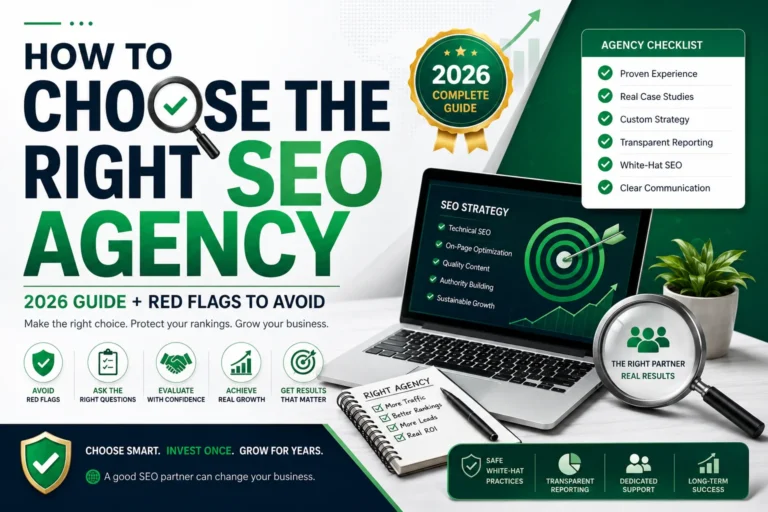
What a Trustworthy SEO Agency Actually Looks Like
- You own your data. Analytics, Search Console, and Google Business Profile stay under your account, always.
- They audit before they pitch. A real strategy starts with a technical and content audit of your actual site, not a generic proposal.
- They combine SEO and GEO. Technical SEO, quality content, and backlinks plus visibility inside AI Overviews and AI-generated answers.
- Reporting connects to business outcomes. Not just rankings, but leads, calls, or sales tied to that traffic.
- They can show real work. Case studies, before/after data, or specific fixes for example, a real click-through-rate problem diagnosed and solved through rewritten title tags and meta descriptions, not just “we improved SEO.”
- Realistic timelines. They’ll tell you 3–6 months for early movement, longer for competitive industries — not “results this week.”
Trustworthy Agency vs. Red-Flag Agency
| Signal | Trustworthy Agency | Red-Flag Agency |
|---|---|---|
| Rankings | Sets realistic expectations, no guarantees | Promises “#1 in 30 days” |
| Data access | You own GA, GSC, GBP accounts | They control your accounts |
| Strategy | Custom, based on a real audit | Same package for every client |
| Backlinks | Relevant, outreach-based, gradual | Bulk, cheap, spammy links |
| Reporting | Traffic + leads + conversions | Traffic numbers only |
| AI/GEO | Can show real AI Overview citations | Claims “AI SEO” with zero proof |
| Contracts | Clear milestones, flexible terms | Long lock-in, no benchmarks |
Questions to Ask Before Hiring an SEO Agency
- Can you walk me through the audit you’d run on my site before proposing a strategy?
- Whose Google Analytics, Search Console, and Business Profile accounts will this be set up under?
- Where do your backlinks come from, and can you show a recent example?
- Can I see live content you’ve written for a client in my industry?
- Do you track visibility in AI Overviews or AI chat answers, and can you prove it with an example?
- What does a monthly report actually include beyond ranking positions?
- What happens if we want to end the contract early?
If an agency answers these clearly and specifically, that’s a strong sign. If they get defensive or vague on more than one, keep looking you’re not being difficult by asking, you’re doing exactly what choosing the right SEO company actually requires.
What About Cost?
SEO pricing varies a lot depending on your industry, competition, and scope of work, so be cautious of anyone quoting a flat number without first understanding your site. If you want a realistic breakdown of what SEO typically costs for a small business and what affects that price, this guide on SEO cost for small businesses in 2026 walks through it in detail. As a general rule: extremely cheap SEO almost always means shortcuts, and extremely expensive SEO doesn’t automatically mean better results it comes down to whether the strategy actually fits your business.
Should You Hire an Agency, a Freelancer, or Do It Yourself?
Not every business needs a full agency retainer right away. If you’re still deciding between handling SEO in-house, hiring a freelancer, or bringing in an agency, it’s worth comparing the trade-offs honestly before committing budget our breakdown on DIY SEO vs. hiring an SEO agency covers exactly when each option makes sense.
See What Other Agencies Are Actually Offering
It also helps to know what the top players in the space look like before you compare quotes. This roundup of top B2B SEO agencies in the USA is a useful reference point if you want to benchmark pricing, services, and positioning before making a final call.
Start With a Free Audit, Not a Sales Call
Before you commit to any agency including ours the smartest first step is getting an honest technical and content audit of where your site actually stands. That single audit reveals your real starting point far better than any sales pitch, and it makes it much easier to judge whether an agency’s proposed strategy actually matches what your site needs. You can see what that looks like with our free SEO audit.
If you’d rather understand exactly what a proper audit should cover before requesting one, this guide on what an SEO audit actually includes breaks it down step by step.
Conclusion
Choosing the right SEO agency isn’t about finding the one with the biggest promises it’s about finding the one that’s honest about what SEO can and can’t do, keeps you in control of your own data, and can actually show its work. Ask the direct questions, watch for the red flags above, and don’t be afraid to walk away from anyone who guarantees outcomes no one can actually control.
Not Sure Where Your Site Actually Stands? Find Out Free.
Before you sign with anyone, get a clear picture of what your site needs not a sales pitch, an actual audit. At Easy Client Hub, we’ll run a full technical and content audit of your site, show you exactly what’s holding your rankings back, and walk you through a strategy built for your business specifically not a copy-paste package.
Claim your free SEO audit here — no obligation, no pressure, just a clear starting point so you know exactly what to look for (and ask) when you talk to any agency, including us.
FAQs
Q: How do I know if an SEO agency is legitimate?
Check whether they let you own your Google Analytics, Search Console, and Business Profile accounts, ask to see real examples of their work in your industry, and see if they can explain their strategy in plain language rather than vague “proprietary” claims. Legitimate agencies are also comfortable being asked direct questions if you get defensiveness instead of clear answers, that itself is a signal.
Q: What is the biggest red flag when hiring an SEO agency in 2026?
Guaranteed rankings are still the most common scam, but a growing 2026-specific red flag is agencies claiming “AI SEO” or AI Overview expertise without being able to prove it with a real, verifiable example. A close second is agencies that insist on managing your Analytics and Search Console under their own account instead of yours that’s a data-ownership risk, not just a convenience.
Q: How much should I expect to pay for SEO services?
Pricing depends on your industry, competition level, and how much work your site needs there’s no universal flat rate. Extremely cheap packages usually rely on shortcuts (spammy links, thin AI content) that risk penalties later, while high prices don’t automatically mean better strategy. A proper quote should follow an audit, not come before one.
Q: How long does it take to see results from a new SEO agency?
Most legitimate campaigns show early movement within 3–6 months, with stronger results building over 6–12 months as authority and content accumulate. Competitive industries or newer websites can take longer. Anyone promising results within days or weeks is not being honest with you SEO is not a paid-ads switch you flip on.
Q: Should a small business hire an SEO agency or do SEO in-house?
It depends on your time, budget, and how competitive your industry is. Businesses with limited time but a real budget usually see faster, more consistent results with an agency, while very small or early-stage businesses sometimes start with DIY basics before scaling up see our full comparison for a clearer breakdown.
Q: What’s the difference between traditional SEO and GEO (Generative Engine Optimization)?
Traditional SEO focuses on ranking in classic Google search results, while GEO focuses on optimizing content so it gets referenced and cited inside AI-generated answers, like Google AI Overviews, ChatGPT, and Gemini. A strong 2026 agency should be actively doing both, not just one.
Q: What should be included in a monthly SEO report?
A proper report goes beyond keyword positions it should show organic traffic trends, Search Console impressions and clicks, technical fixes completed that month, content published, backlinks earned, and ideally a connection to leads or conversions. If a report is just a list of rankings with no context, ask for more.
Q: Can I switch SEO agencies if I’m not happy with results?
Yes, but check your contract terms first this is exactly why long lock-in contracts without exit clauses are a red flag. Before switching, make sure you have full ownership of your Analytics, Search Console, and any content or backlink records, so you don’t lose your SEO history in the process.
Q: Is it normal for an SEO agency to ask for admin access to my website?
Yes, this is normal and often necessary for technical fixes, but access should always be granted through your own hosting or WordPress account not by handing over full ownership. A reasonable agency will ask for a user role with the right permissions, not a full account transfer.