Category: SEO Tips & Strategies | Reading Time: 8 min | Updated: June 2026
About the Author: This guide is written by the team at Easy Client Hub — a digital marketing agency specializing in SEO, backlink building, and WordPress development. We have helped businesses improve their Google rankings through hands-on, real-world SEO work. Everything in this guide is based on strategies we actively use and test for our own clients in 2026.
Want to rank higher on Google without spending a single rupee on ads? You are in the right place. In 2026, SEO (Search Engine Optimization) is still the most powerful free tool available to students, freelancers, and small business owners who want consistent organic traffic. The rules have evolved Google now uses AI-powered search, featured snippets, and E-E-A-T signals but the opportunity is bigger than ever.
In our work at Easy Client Hub, we have seen new websites go from zero traffic to thousands of monthly visitors using nothing but these free SEO strategies. No paid ads. No expensive tools. Just consistent, smart SEO work.
In this guide, we walk you through 7 proven, free SEO tips for 2026 that actually work. Whether you are a complete beginner or a freelancer trying to grow your online presence, these strategies will help you improve your Google ranking starting today.
What is SEO and Why Does It Matter in 2026?
SEO stands for Search Engine Optimization the process of improving your website so it appears higher in Google search results. In 2026, over 90% of online experiences still begin with a search engine. If your website is not showing up on page one, you are practically invisible to your potential audience.
Here is what we know from working directly with clients: businesses that invest in SEO consistently outperform those relying only on paid ads because SEO traffic is free, sustainable, and compounds over time. A blog post we optimized for a client in early 2025 still brings in over 800 monthly visitors today without a single rupee spent on promotion.
The core of SEO is completely free. You do not pay Google to rank you earn your position by creating helpful, relevant, and well-optimized content.
Tip #1: Do Proper Keyword Research (Free Tools Only)
Keyword research is the foundation of every successful SEO strategy. Before writing any blog post or web page, you need to know what your target audience is actually searching for on Google. In our experience, this single step is what separates blogs that rank on page one from blogs that nobody ever finds.
Best free keyword research tools in 2026:
- Google Keyword Planner — Most accurate free search volume data directly from Google
- Google Search Console — See which keywords already bring traffic to your site
- Google Autocomplete & People Also Ask — Real user searches, completely free
- Ubersuggest (Free Plan) — Great for finding long-tail keywords with low competition
Pro Tip from our team: When we do keyword research for new websites, we always start with long-tail keywords like “free SEO tips for small businesses 2026” instead of just “SEO tips.” A new website has almost zero chance of ranking for a broad keyword but a well-written post targeting a long-tail keyword can hit page one within 3 months.
Target keywords for this blog: SEO tips 2026, how to rank higher on Google for free, free SEO tips for beginners, on-page SEO tips 2026, SEO tips for freelancers.
Tip #2: Optimize Your On-Page SEO (The Right Way)
On-page SEO means optimizing the content and structure of each individual page on your website. This is 100% free and completely in your control. In 2026, Google’s algorithm heavily weighs on-page signals especially keyword placement, content structure, and user experience.
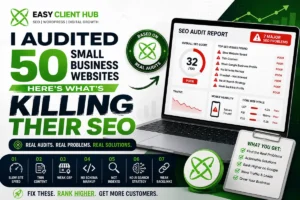
We audited dozens of websites at Easy Client Hub and found one common pattern: most websites losing rankings were making the same basic on-page SEO mistakes missing meta descriptions, keyword-stuffed titles, and zero internal linking. Fixing these alone boosted their rankings significantly within weeks.
On-page SEO checklist for every blog post:
- Put your main keyword in the Title Tag (H1) preferably at the start
- Write a compelling Meta Description under 160 characters including your keyword
- Use your keyword naturally in the first 100 words of your content
- Use H2 and H3 subheadings with related keywords
- Add alt text to every image using relevant keywords
- Keep your URL short, clean, and keyword-rich (e.g. /seo-tips-2026)
Need professional on-page SEO done for your website? Check out our SEO Services at Easy Client Hub.
Tip #3: Create High-Quality, E-E-A-T Content
In 2026, Google’s biggest content ranking standard is Experience, Expertise, Authoritativeness, and Trustworthiness (E-E-A-T). Google does not just want keyword-stuffed content. It wants genuinely helpful content written by someone who has real experience with the topic.
What Each E-E-A-T Element Means (And How to Apply It)
Experience:
Google wants to see that you have first-hand experience with what you are writing about. Share your own results, screenshots, numbers, and real-world examples. For instance, instead of writing “backlinks help SEO,” write “after building 15 backlinks to our client’s website over 6 weeks, their domain authority jumped from 4 to 18 and organic traffic doubled.” That is Experience in action.
Expertise:
Demonstrate that you know your subject deeply. Use correct terminology, explain concepts clearly, and go beyond surface-level advice. Cover topics comprehensively Google in 2026 strongly prefers long-form content (1500+ words) that answers every related question a reader might have.
Authoritativeness:
Build your site’s authority by getting mentioned or linked to from other trusted websites. Create an About page that highlights your team’s background and credentials. Add an author bio to every blog post. The more Google sees other trusted sources referencing your content, the more authoritative your site becomes.
Trustworthiness:
Trust signals include having an SSL certificate (HTTPS), a visible contact page, a privacy policy, clear business information, and genuine customer reviews. Google’s algorithm in 2026 actively looks for these signals to decide whether your site is safe and reliable to recommend.
Real Example: One of our clients was publishing 500-word blog posts with no author bio, no real data, and generic advice. After we rewrote their top 5 posts with personal experience, real statistics, and a proper author bio their average ranking jumped from position 24 to position 7 within 8 weeks.
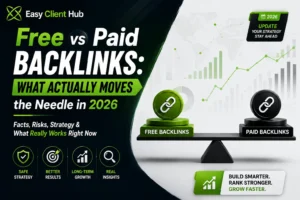
Tip #4: Build Free Backlinks to Boost Your Authority
Backlinks links from other websites pointing to yours are still one of the strongest ranking signals in 2026. According to Ahrefs data, the number one result on Google has on average 3.8x more backlinks than positions two through ten. The good news is that you can build quality backlinks completely for free.
Free backlink building methods that work in 2026:
- Guest posting on relevant blogs in your niche
- Answer questions on Quora and Reddit with links back to your content
- Create profiles on Medium, Pinterest, Behance, and Dev.to with links
- Submit your site to free business directories and niche listings
- Create shareable content infographics, statistics posts, and how-to guides attract natural links
Want a done-for-you backlink strategy? Explore our professional Backlink Building Service for faster results.
Tip #5: Optimize for Mobile and Page Speed
In 2026, Google uses mobile-first indexing meaning it ranks the mobile version of your website, not the desktop version. If your site loads slowly or looks broken on a phone, your rankings will suffer no matter how good your content is.
Google’s own research shows that 53% of mobile users abandon a website that takes more than 3 seconds to load. A 1-second delay in page load time can reduce conversions by 7%. These are not small numbers speed directly affects both your rankings and your revenue.
Free ways to improve mobile SEO and page speed:
- Use Google PageSpeed Insights (free) to identify and fix speed issues
- Compress all images before uploading use free tools like TinyPNG
- Use a lightweight WordPress theme (Astra, GeneratePress) for faster loading
- Enable caching with a free plugin like W3 Total Cache or LiteSpeed Cache
- Make sure your website is 100% responsive on all screen sizes
Tip #6: Use Internal Linking Strategically
Internal linking means linking from one page of your website to another. It is one of the most underrated free SEO techniques in 2026. Internal links help Google understand your site structure, distribute page authority, and keep visitors on your site longer — all of which improve your rankings.
Smart internal linking tips:
- Link to your most important service or product pages from every blog post
- Use descriptive anchor text containing keywords not just ‘click here’
- Add 3 to 5 internal links per blog post for best results
- Link newer posts to older related posts to build topic authority clusters
For example, if you need a complete digital marketing strategy beyond just SEO, we have got you covered with full-service solutions.
Tip #7: Optimize for AI Search and Google Featured Snippets
2026 is the year of AI-powered search. Google’s AI Overviews, ChatGPT search, and Perplexity are now pulling content directly from websites and showing answers without users clicking through. This is a massive shift and websites that structure their content correctly are getting enormous visibility.
How to optimize for AI search and featured snippets:
- Answer the main question directly in your first paragraph within 60 to 80 words
- Use question-based H2 headings like ‘What is…’, ‘How to…’, ‘Why does…’
- Add a short FAQ section at the end of every blog post
- Include recent data, statistics, and original insights AI systems love citing fresh data
- Use structured formatting: bullet points, numbered lists, and clear headings
Websites ranking in Google Featured Snippets get significantly higher click-through rates even from position 2 or 3. Optimizing for snippets is one of the highest-ROI free SEO tactics in 2026.
Common SEO Mistakes to Avoid in 2026
Even experienced website owners make these mistakes. Avoid them to protect your rankings:
- Keyword stuffing Google penalizes unnatural, forced keyword repetition
- Publishing thin, low-quality AI-generated content without editing or adding real value
- Ignoring technical SEO broken links, missing sitemaps, and slow pages hurt rankings
- Not updating old content outdated posts lose rankings fast in 2026
- Targeting keywords that are too competitive for a new website
- Skipping Google Search Console setup it is free and essential for tracking rankings
Conclusion: SEO in 2026 Is Still the Best Free Marketing Strategy
Ranking higher on Google for free in 2026 is absolutely achievable but it requires consistency, strategy, and patience. The seven tips we covered keyword research, on-page SEO, E-E-A-T content, backlink building, page speed, internal linking, and AI search optimization form a complete roadmap that any beginner, freelancer, or small business owner can follow without spending a single rupee.
Based on our real experience working with clients at Easy Client Hub: the websites that win at SEO are not the ones with the biggest budgets they are the ones that stay consistent, write genuinely helpful content, and keep improving. Start with one or two tips from this guide, implement them this week, and track your progress in Google Search Console.
If you need help implementing these SEO strategies, the team at Easy Client Hub can help you create a customized SEO plan based on your goals and competition.
Frequently Asked Questions (FAQs)
How long does it take to rank on Google for free?
For low-competition keywords, most websites start seeing results within 3 to 6 months of consistent SEO work. High-competition keywords can take 6 to 12 months. In our experience at Easy Client Hub, websites that publish at least 2 to 3 optimized posts per month and consistently build backlinks tend to see results fastest.
Can I do SEO without any paid tools?
Yes, absolutely. Google Keyword Planner, Google Search Console, Google Analytics, and Google PageSpeed Insights are all free and provide everything you need to build a solid SEO foundation in 2026. Paid tools like Ahrefs or SEMrush are helpful but not required to start ranking.
What is the most important SEO tip for beginners in 2026?
Focus on long-tail keywords and create genuinely helpful, in-depth content. New websites cannot compete for broad, high-volume keywords. Target specific, low-competition phrases and write the most comprehensive answer to your reader’s question that is the fastest path to page one for a new site.
Does social media help with SEO rankings?
Social media is not a direct Google ranking factor, but it helps indirectly. When you share content on social platforms, it increases visibility, drives traffic, and can attract natural backlinks all of which positively impact your SEO in 2026.
Is SEO still worth it in 2026 with AI search growing?
More than ever. AI search tools like Google AI Overviews and ChatGPT actually pull their answers from well-optimized, authoritative websites. This means good SEO now gets you visibility in both traditional search results AND AI-generated answers doubling your exposure for the same amount of work.