If you’ve been doing SEO for a while, you’ve probably felt it something shifted. Rankings that used to be predictable started fluctuating. Traffic dropped on pages you didn’t even touch. And suddenly, everyone’s talking about “AI Overviews,” “GEO,” and “zero-click searches.”
Here’s the honest truth: SEO is not dead. But the old way of doing SEO is quickly becoming less effective on its own.
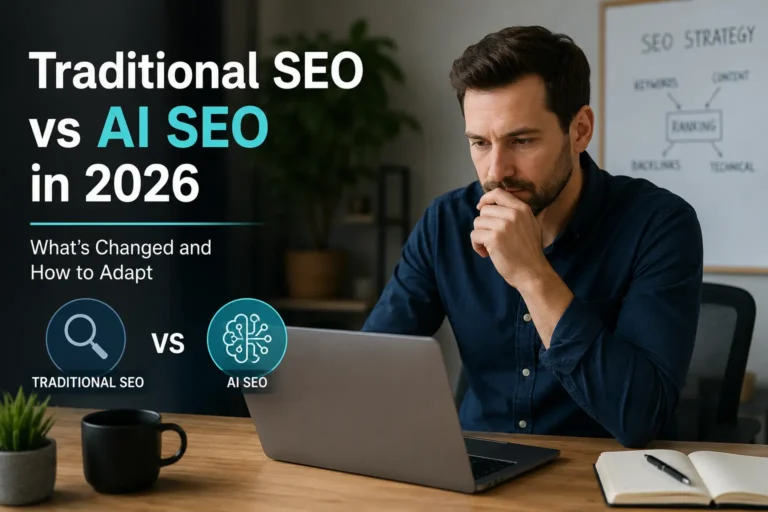
In this guide, we’re going to break down the real difference between traditional SEO vs AI SEO in 2026 what changed, what stayed the same, and most importantly, what you need to do right now to stay visible in both Google and AI-powered search engines.
Whether you’re a business owner, a freelancer, or a digital marketer trying to keep up, this post is written for you.
What Is Traditional SEO? (A Quick Recap)
Traditional SEO is the practice of optimizing your website so it ranks higher in Google’s organic search results. It’s been around since the early 2000s, and for years, the formula was fairly consistent:
- Find keywords people search for
- Build pages around those keywords
- Get backlinks from other websites
- Fix technical issues so Google can crawl your site
- Optimize on-page elements like title tags, meta descriptions, and headers
The goal was simple: rank on page one of Google, get clicks, get traffic.
And for a long time, this worked beautifully. A well-optimized blog post targeting a keyword with decent volume could bring in thousands of visitors every month consistently.
Traditional SEO also gave businesses a lot of control. You could track rankings, monitor organic traffic, measure click-through rates, and see exactly which pages were performing. Tools like Ahrefs, SEMrush, and Google Search Console made the whole process measurable and repeatable.
At its core, traditional SEO relied on one fundamental principle: match the keywords people type into Google, and make sure your content is good enough to deserve a top spot.
This foundation isn’t going away. But the game has gotten a lot more complex.
What Is AI SEO in 2026? (And Why It’s Different)
AI SEO also called Generative Engine Optimization (GEO) or Answer Engine Optimization (AEO) is the practice of optimizing your content so that AI-powered search tools find, understand, and cite it in their responses.
We’re talking about tools like:
- Google AI Overviews (the AI summaries at the top of search results)
- ChatGPT Search
- Perplexity AI
- Google Gemini
- Microsoft Copilot
These platforms don’t just return a list of links. They read your content, extract the most relevant information, and compose an answer for the user often without the user ever clicking on a single website.
Here’s what makes AI SEO fundamentally different:
Traditional SEO optimizes for rankings. You want to appear at position #1 on Google’s results page.
AI SEO optimizes for citations. You want AI systems to recognize your content as credible, accurate, and well-structured enough to reference in their answers.
The mindset shift is significant. In traditional SEO, the goal is to attract clicks. In AI SEO, the goal is to become the source that AI trusts.
If you want to go deeper into how AI search works and what it means for your business, our team at Easy Client Hub has been researching and implementing these strategies for clients across multiple industries.
The Numbers That Should Make You Pay Attention
Before we go any further, let’s look at what’s actually happening in search right now:
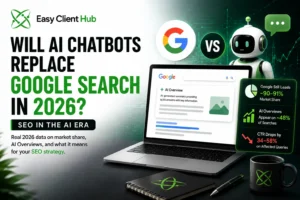
- AI Overviews appear in approximately 48% of all Google searches as of early 2026 up from 34.5% just a few months ago
- When an AI Overview appears, the #1 organic result receives 58% fewer clicks than it would without one
- 86% of SEO professionals have already integrated AI into their workflows
- 50% of consumers are now intentionally using AI-powered search tools as their primary way to find information
- AI-referred traffic, while lower in volume, converts 23x higher than regular organic search visitors
Let that sink in. You can rank #1 on Google and still lose more than half your clicks to an AI summary sitting above your result.
This is not a future problem. It’s happening right now and it’s exactly why understanding the difference between traditional SEO and AI SEO in 2026 is no longer optional.
Traditional SEO vs AI SEO: Key Differences Explained
Let’s break this down clearly. These two approaches aren’t opposites but they require different thinking.
1. How Keywords Work
Traditional SEO: You research keywords, find ones with decent search volume and manageable competition, and build content around those exact phrases. Matching the keyword is the core signal.
AI SEO: Keywords still matter, but AI systems understand context and intent, not just matching words. When someone asks ChatGPT or Perplexity a question, they’re not typing a two-word keyword they’re having a conversation. Research shows that between 65% and 85% of ChatGPT prompts have no matching keyword in SEMrush’s database. That means traditional keyword research alone leaves a massive blind spot.
In 2026, strong content needs to cover the topic thoroughly, answer questions naturally, and use related terms and concepts not just stuff in a target keyword.
2. What You’re Optimizing For
Traditional SEO: You’re optimizing for Google’s ranking algorithm. Signals include backlinks, page speed, mobile-friendliness, keyword placement, and hundreds of other technical factors.
AI SEO: You’re optimizing for AI comprehension. AI systems look for content that is clear, factually accurate, well-structured, and easy to extract answers from. They favor content with strong E-E-A-T (Experience, Expertise, Authoritativeness, and Trustworthiness) signals — author credentials, cited sources, original data, and genuine first-hand insight.
3. The Success Metric
Traditional SEO: Rankings, organic traffic, click-through rate.
AI SEO: Citation rate (how often your content is referenced in AI answers), brand mentions in AI responses, AI referral traffic, and share of voice in AI-generated results.
4. Content Structure
Traditional SEO: Long-form content with keywords in headings, introduction, and throughout the body. Internal linking and meta tags matter a lot.
AI SEO: Content needs to be structured for extraction. Clear headings, concise paragraphs, direct answers to specific questions, FAQs, bullet points, and factual statements all help AI systems understand and cite your content. Think: “citation-worthy,” not just “keyword-optimized.”
5. Backlinks vs Brand Authority
Traditional SEO: Backlinks from authoritative sites are one of the strongest ranking signals.
AI SEO: Branded web mentions being talked about across the internet, even without a hyperlink have a 0.664 correlation with AI Overview appearances, compared to just 0.218 for backlinks. That’s a massive difference in signal strength.
What Is Generative Engine Optimization (GEO)?
You’ll hear this term more and more in 2026. Generative Engine Optimization (GEO) is a newer discipline that focuses specifically on getting your content cited inside AI-generated answers.
Unlike traditional SEO where you’re trying to rank in a list of links, GEO is about becoming the source AI trusts when answering your audience’s questions.
Here’s what GEO involves:
- Entity clarity — making sure your brand, products, and services are described consistently and clearly across the web
- Content extractability — writing in a way that makes it easy for AI to pull out specific facts, definitions, and answers
- Multi-platform presence — showing up not just on your website, but on Reddit, YouTube, industry publications, and social platforms (all frequently cited by AI tools)
- Structured data — using schema markup so AI can better understand what your content is about
- Authoritative sourcing — citing statistics, studies, and credible references in your content
Think of GEO as SEO for the AI era. The fundamentals of being genuinely helpful, accurate, and authoritative still apply but the delivery needs to be optimized for machines that generate answers, not just rank pages.
Our SEO services at Easy Client Hub now incorporate both traditional SEO and GEO strategies to make sure your content performs across every surface from Google’s blue links to AI-generated summaries.
Why Traditional SEO Still Matters (Don’t Abandon It)
Here’s what gets lost in the “AI is changing everything” conversation: traditional SEO is not dead.
Google still processes roughly 14 billion searches per day. Google accounts for approximately 89.6% of global search engine use as of 2025. The traditional ten blue links are still there they still drive enormous amounts of traffic and all of that still runs on the same fundamentals that have always driven SEO.
More importantly: AI systems actually depend on traditional SEO to work.
AI Overviews, ChatGPT Search, and Perplexity don’t invent content. They pull from indexed, authoritative web pages. If your site is slow, poorly structured, has thin content, or lacks credibility signals, AI tools won’t reference it regardless of how well you understand GEO.
Traditional SEO is the foundation. AI SEO is the next layer on top.
If you abandon traditional SEO chasing AI optimization, you’ll lose traffic on both fronts. The winning strategy in 2026 is to do both.
How to Build a Hybrid SEO Strategy for 2026
Now let’s get practical. Here’s how to combine traditional SEO and AI SEO into a single strategy that works.
Step 1: Start With Strong Technical SEO
Before anything else, make sure Google can crawl and index your site properly. This means:
- Fast page load speed (under 3 seconds)
- Mobile-friendly design
- Clean site structure with logical internal linking
- No broken links or crawl errors
- Proper use of title tags, meta descriptions, and header hierarchy
Also check your robots.txt file. Many websites are accidentally blocking AI crawlers like GPTBot, Google-Extended, and Perplexity Bot which removes you from AI citation eligibility entirely.
Need help with a full technical audit? Our team offers a comprehensive SEO service that covers both traditional and AI-era optimization.
Step 2: Write for Humans, Structure for AI
The biggest content shift in 2026 is this: write naturally and conversationally (as if you’re explaining to a smart friend), but structure your content so AI can extract information easily.
Practical tips:
- Lead with a clear, direct answer to the main question in your post don’t bury the answer in paragraph five
- Use descriptive H2 and H3 headings that mirror how people ask questions
- Add an FAQ section at the end of every post targeting long-tail questions around your topic
- Include original data, statistics, and citations — AI systems favor content that references credible sources
- Write at a readable level — short sentences, short paragraphs, and natural language win over jargon-heavy content
Step 3: Build E-E-A-T Into Everything
E-E-A-T stands for Experience, Expertise, Authoritativeness, and Trustworthiness. It’s Google’s framework for evaluating content quality and it’s equally important for AI citation.
For your blog posts:
- Add an author bio with real credentials and experience
- Link to authoritative external sources when citing data or making claims
- Show first-hand experience — case studies, real results, personal observations
- Keep your content updated regularly — outdated posts signal low trustworthiness
Step 4: Build Backlinks and Brand Mentions
Both matter in 2026 they serve different purposes.
Backlinks still strengthen your domain authority for traditional Google rankings. Focus on quality over quantity: one link from a relevant, authoritative site is worth more than fifty low-quality directory links.
If you need help with this, check out our backlink service we build high-quality, white-hat links that improve rankings without the risk of penalties.
Brand mentions (even without a link) help establish entity authority for AI citation. Getting mentioned in industry publications, Reddit discussions, YouTube reviews, and niche forums all contribute to how AI systems perceive your brand’s credibility.
Step 5: Add Schema Markup
Schema markup is structured data that tells search engines and AI systems exactly what your content is about. For blog posts, implement:
- BlogPosting schema — tells Google and AI the title, author, date, and topic of your post
- FAQPage schema — increases chances of appearing in AI answers for question-based queries
- Organization schema — establishes your brand’s entity in Google’s knowledge graph
Step 6: Track the Right Metrics
Traditional metrics (rankings, organic traffic) still matter. But in 2026, add these to your reporting:
- Are your pages appearing in Google AI Overviews for your target keywords?
- Is your brand being mentioned when you query your niche on ChatGPT or Perplexity?
- What’s the CTR trend on pages where AI Overviews are present?
- Are you getting any referral traffic from ChatGPT, Perplexity, or Gemini?
Common Mistakes Businesses Are Making Right Now
Knowing what not to do is just as valuable. Here are the most common errors we see businesses making in 2026:
1. Treating AI SEO as optional — If 48% of searches show an AI Overview, ignoring it means ignoring half your potential visibility.
2. Blocking AI crawlers — One in three B2B websites is accidentally blocking AI bots in their robots.txt. Check yours today.
3. Publishing thin, AI-generated content — Ironically, using AI to mass-produce generic content hurts both your Google rankings and your chances of being cited by AI. AI systems favor original, deep, human-driven insight.
4. Abandoning backlink building — Some marketers are pivoting entirely to “AI optimization” and dropping link building. Don’t. Backlinks still directly impact your traditional rankings, which AI systems still pull from.
5. Ignoring structured data — Schema markup is one of the clearest ways to tell AI systems what your content is about. Not using it is a missed opportunity.
What This Means for Your Business
If you run a small business, an e-commerce store, or a service-based company, the implication is straightforward:
Your customers are searching for what you offer but increasingly, they’re asking AI tools instead of typing queries into Google. If your business isn’t visible in AI-generated answers, you’re invisible to a growing segment of potential customers.
The good news? Most businesses haven’t figured this out yet. The ones who adapt early will have a significant competitive advantage.
At Easy Client Hub, we help businesses build SEO strategies that work for both traditional search and the AI era. From technical optimization to content strategy and digital marketing, we cover every piece of the puzzle.
If you want to know where your website stands and what needs to change, get in touch with us we’ll take a look and tell you exactly what to prioritize.
Final Thoughts
The search landscape in 2026 is genuinely more complex than it was even two years ago. But the underlying principle hasn’t changed: create content that is genuinely useful, accurate, and trustworthy and make sure it’s structured so both humans and machines can understand it.
Traditional SEO gives you the foundation. AI SEO future-proofs your visibility. Together, they form the only strategy that makes sense in 2026.
The businesses that treat this as an either/or choice will fall behind. The ones who integrate both will be the ones showing up whether a user types a query into Google, asks ChatGPT a question, or searches on Perplexity.
If you’re not sure where to start, we’re here to help. Explore our full range of services or reach out directly let’s build an SEO strategy that works for where search is going, not just where it’s been.
FAQs
Is traditional SEO dead in 2026?
No. Google still processes billions of searches daily and traditional signals like backlinks, page speed, and on-page optimization still matter. But traditional SEO alone is no longer enough — you also need to optimize for AI-generated results.
What is the difference between traditional SEO and AI SEO?
Traditional SEO targets ranking positions in Google’s link-based results. AI SEO (GEO) targets being cited inside AI-generated answers on platforms like Google AI Overviews, ChatGPT, and Perplexity.
What is GEO (Generative Engine Optimization)?
GEO is the practice of optimizing your content so AI-powered tools can find, understand, and cite it in their answers. It focuses on content clarity, entity consistency, E-E-A-T signals, and structured data.
How do I rank in Google AI Overviews?
Write direct answers, use descriptive headings, add FAQPage and BlogPosting schema, build E-E-A-T signals, and make sure AI crawlers like GPTBot are not blocked in your robots.txt.
How to optimize content for ChatGPT and other AI tools?
Write accurate, well-structured content with clear answers near the top. Cite credible sources, keep content updated, and maintain a consistent brand presence across multiple platforms.
What is AEO — Answer Engine Optimization?
AEO focuses on appearing as direct short answers in AI tools and featured snippets. It is similar to GEO but targets concise one-answer responses rather than long-form contextual AI results.
Published by the Easy Client Hub Team — a digital marketing agency helping businesses grow through smart SEO, content strategy, and web development. Learn more about us.