Your website ranks on Page 1 of Google. But nobody visits it.
Sound familiar? In 2026, this is the reality for thousands of businesses. 60% of searches now end without a single click because AI tools like ChatGPT, Perplexity, and Google AI Overviews are answering questions directly before users ever reach your website.
This is not a small shift. 94% of brands invest heavily in traditional SEO, yet 62% are completely invisible to generative AI models.
The solution is GEO Generative Engine Optimization. And in 2026, businesses that understand the difference between SEO vs GEO are the ones winning online visibility.
This guide covers everything what SEO and GEO are, how they differ, which is better, and how to combine both for maximum results in 2026.
What Is SEO?
SEO stands for Search Engine Optimization. It is the process of optimizing your website to rank higher in Google search results and drive organic traffic.
SEO includes keyword research, on-page optimization, backlink building, site speed improvements, and technical fixes. It has been the foundation of digital marketing for over 20 years.
SEO is still essential in 2026 but it is no longer the complete picture.
Before you optimize for GEO, make sure your SEO foundation is solid. Read our guide: What Is an SEO Audit? Complete Guide & Free Tools 2026
What Is GEO — Generative Engine Optimization?
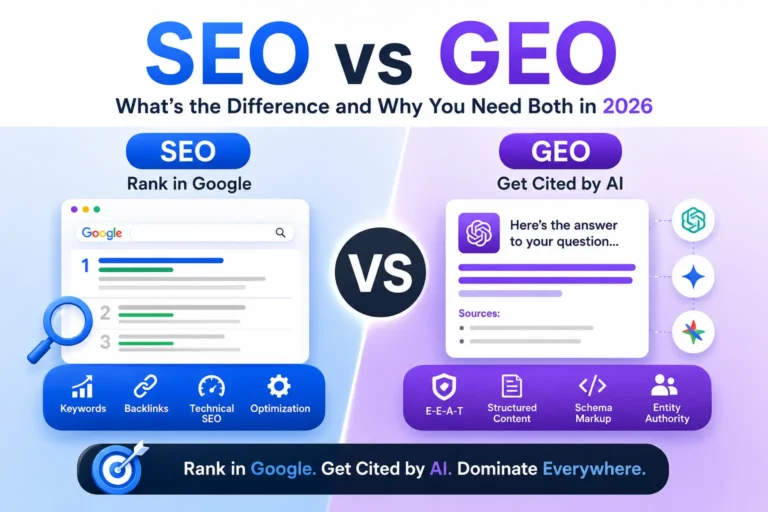
GEO stands for Generative Engine Optimization. It is the practice of structuring, writing, and publishing content so that AI language models ChatGPT, Perplexity, Google Gemini, Google AI Overviews, and Claude cite it when answering user queries.
Traditional SEO optimizes for ranking positions in a list of blue links. GEO optimizes for inclusion in an AI-generated answer.
In simple terms: SEO gets you ranked. GEO gets you cited.
What Does GEO Mean in SEO?
GEO is not a replacement for SEO it is an upgrade. 99% of AI Overviews cite the organic top 10, which means SEO is still the foundation for GEO. You have to rank well first to have a chance of being cited.
Think of GEO as the next layer on top of your existing SEO strategy. Without strong SEO, your GEO efforts will not work either.
SEO vs GEO — Key Differences
| SEO | GEO | |
| Full Name | Search Engine Optimization | Generative Engine Optimization |
| Goal | Rank in Google results | Get cited in AI answers |
| Target Platforms | Google, Bing | ChatGPT, Perplexity, Google AI Overviews |
| Main Focus | Keywords, backlinks, technical SEO | E-E-A-T, structured content, authority |
| Traffic Type | Click-based organic traffic | AI citations and brand impressions |
| Content Style | Keyword-optimized pages | Expert, factual, well-structured content |
| Result | Page 1 ranking | Featured in AI-generated answers |
| Also Known As | Traditional SEO | AI SEO, LLMO, AEO |
| Replaces Each Other? | ❌ No | ❌ No — both needed |
Is SEO Being Replaced by GEO?
No, but SEO alone is no longer enough.
The most effective strategy in 2026 combines both disciplines, using strong SEO foundations to support GEO visibility.
The urgency is real though. AI Overviews reduce organic click-through rates by 61%. However, when AI Overviews cite your content, your CTR jumps 35% higher than pages they ignore.
Google rankings still drive traffic but AI citations now drive conversions even faster.
Is GEO Part of SEO?
Search engines rank pages. Generative engines synthesize answers. Optimizing for a ranking is a different problem from optimizing for an answer.
GEO is a separate discipline that works alongside SEO. They share some foundations good content, E-E-A-T, technical hygiene but GEO requires additional focus on content structure, citation-friendliness, and entity authority.
GEO sometimes also called Answer Engine Optimization, LLMO, or GAIO, is developing into the new standard in search engine optimization.
Which Is Better — SEO or GEO?
Neither is better alone. SEO still drives higher raw volumes of click-based website traffic for most industries. GEO drives brand impressions, citations, and high-intent visits from AI search users.
But here is what makes GEO so powerful: AI-referred traffic converts at 14.2% compared to Google organic’s 2.8%. GEO delivers 4.4x higher conversions than traditional SEO.
The best strategy in 2026 uses both together.
SEO vs GEO — Business Impact
| Metric | SEO | GEO |
| Traffic Volume | High | Growing fast |
| Conversion Rate | 2.8% average | 14.2% average |
| Brand Visibility | Google rankings | AI answer citations |
| Time to Results | 3 to 6 months | 1 to 3 months |
| ROI | Strong | $3.71 per $1 invested |
| Zero Click Impact | Affected | Protected |
One B2B brand achieved 10% of organic visits from generative engines within 90 days of implementing GEO best practices, with 27% of that traffic converting to qualified leads.
How to Improve GEO — AI Search Optimization Tips for 2026
1. Write Answer-First Content
The first 200 words of any article should directly and completely answer the primary query not build up to the answer.
2. Build E-E-A-T Signals
AI systems evaluate author expertise, trust, and authority before citing a source. Add author bios, cite sources, and keep content factually accurate.
3. Add Schema Markup
Schema markup helps AI systems understand your content and increases the chance of being cited in ChatGPT SEO and Perplexity SEO results.
4. Focus on Entities Not Just Keywords
Generative engines parse meaning, not keywords. Content optimized for GEO is structured around clearly defined entities, claims, and relationships.
5. Allow AI Bots to Crawl Your Site
Check your server logs for the ChatGPT-User agent to confirm AI bots are visiting your site. If you use Cloudflare, your AI bot traffic may have been blocked automatically.
6. Use Statistics and Data
YouTube mentions and branded web mentions have the strongest correlation with AI visibility. Content depth and readability scores also correlate with higher citation rates.
The Future of SEO — What to Expect
The biggest shift in 2026 is that search happens everywhere. Google, ChatGPT, Perplexity, and even social discovery engines like TikTok and Reddit are now entry points for discovery. Optimizing for one no longer guarantees visibility across others.
The GEO market will expand from $886 million to $7.3 billion by 2031 growing at 34% every year.
Businesses that start building GEO visibility today will have a massive advantage over those who wait.
Want to understand more about how AI is reshaping search? Read our full guide: Traditional SEO vs AI SEO 2026
SEO vs GEO Strategy for 2026
The smartest strategy is not SEO or GEO it is SEO plus GEO together.
Here is how to combine both:
- Keep doing traditional SEO — keywords, backlinks, technical fixes
- Add answer-first content structure to every new blog post
- Add schema markup to all pages
- Build E-E-A-T — author bios, citations, expert content
- Monitor AI citations — search your brand name in ChatGPT and Perplexity regularly
- Allow AI bots to crawl your site
Need a professional SEO and GEO strategy built for your business? Check out our SEO Services at Easy Client Hub.
FAQs
What is GEO in SEO?
GEO stands for Generative Engine Optimization. It is the process of optimizing content to get cited in AI-generated answers from ChatGPT, Perplexity, and Google AI Overviews.
Is SEO being replaced by GEO?
No. SEO and GEO work together. SEO drives Google rankings while GEO gets your content cited in AI answers. Both are needed in 2026.
Which is better: SEO or GEO?
Neither is better alone. SEO drives more raw traffic volume while GEO drives higher-converting AI traffic. The best strategy combines both.
What does GEO mean in digital marketing?
GEO means Generative Engine Optimization optimizing your content so AI systems like ChatGPT and Perplexity recommend and cite your brand.
How can I improve my GEO?
Write answer-first content, build E-E-A-T signals, add schema markup, use structured data, include statistics, and make sure AI bots can crawl your site.
Is GEO part of SEO?
GEO is a separate but complementary discipline. They share foundations like good content and technical optimization, but GEO requires additional focus on content structure and citation-friendliness.
What is the future of SEO?
The future of SEO is a combination of traditional SEO and GEO. Brands that master both will dominate visibility across Google search and AI-powered answer engines in 2026 and beyond.
Conclusion
In 2026, ranking on Google is still important but it is no longer enough on its own.
60% of searches end without a click, and the click rate at position 1 with an AI Overview is only 2.6%. If your content is not showing up in AI answers, you are losing visibility every single day.
SEO builds your foundation. GEO builds your future. Together, they give your business maximum visibility across every search channel Google, ChatGPT, Perplexity, and beyond.
Businesses that optimize only for Google are missing a growing audience that discovers brands through AI-powered search. By combining SEO and GEO, you can increase visibility, traffic, and conversions across both traditional and AI search platforms. Start building your future-proof search strategy today with Easy Client Hub.
Ready to build a future-proof SEO and GEO strategy? Contact Easy Client Hub today and let our experts get your business visible everywhere.
About the Author
Aoon Muhammad is an SEO Specialist and Co-Founder of Easy Client Hub — a digital marketing agency helping businesses grow their online visibility through SEO, backlink building, and content strategy. With hands-on experience managing SEO campaigns across multiple industries, Aoon specializes in both traditional SEO and modern GEO strategies for 2026.